
Tom Zohar
I am an Associate Professor at CEMFI. My research applies causal inference methods to large-scale administrative datasets to understand the structural drivers of labor market inequality. My current research focuses on two primary areas:
• Labor Market Inequality: Investigating the role of firm-level sorting and worker mobility in driving inequality of opportunities.
• Social Norms & Fertility: Examining how institutional and social factors influence reproductive health decisions and subsequent labor supply.
I'm a Research Affiliate at CESifo, Inclusion Lab, and Laboratorio de Oportunidades, and an IZA@LISER Network Member. I received my PhD from Stanford University in 2021.
Quantifying the Role of Firms in Intergenerational Mobility
(Forthcoming at AEJ:Applied)
with Caue Dobbin
Audio summaryCESifo Working Paper
We quantify the role of firms in intergenerational mobility using administrative data from Israel. We decompose the intergenerational elasticity of earnings (IGE) into an individual-IGE and a firm-IGE using an AKM framework. The firm-IGE—reflecting the sorting of children from higher-income families into better-paying firms—accounts for 23 percent of the IGE. We then explore underlying mechanisms. While skill transmission explains part of the firm-IGE, roughly half cannot be accounted for by skill differences. Moreover, sector-level sorting explains a large share of the firm-IGE, indicating that structural barriers across sectors—rather than firm-level discrimination—are a key driver of intergenerational sorting.

The Complementary Role of Information and Contraceptive Access in Teen Pregnancy
(Journal of Development Economics, 2026)
with Sevin Kaytan and Stwarth Piedra Bonilla
Audio summaryCESifo Working Paper
RFBerlin Discussion Paper
We investigate how information frictions affect the efficacy of contraception provision programs. We study a Costa-Rican initiative that combined two pillars: free access to long-acting-reversible contraceptives, and a tailored information campaign to raise awareness and correct for baseline misperceptions. Using administrative data and geographic variation in the initiative, we find a 16% decrease in the teen birth rate. We show information complements access: districts exposed to both pillars experience substantially larger reductions than those with contraception access alone. Using surveys on sexual behavior, we show the initiative shifted the information source from personal networks to healthcare professionals, amending misperceptions on sexual health.

Women's Autonomy and Abortion Decision-Making
(R&R at Journal of Political Economy)
with Nina Brooks and Caue Dobbin
Audio summaryWe study how abortion subsidies affect abortion take-up using administrative data covering the universe of legal abortions in Israel. Leveraging a reform that expanded eligibility for government funding of abortion, we find that the subsidy increased the share of pregnancies ending in abortion by 6.8 percentage points, with the effect concentrated among young women from backgrounds with strict views on abortion (14.8 percentage points). We propose a model of the family in which the daughter is liquidity constrained: she earns little at the time of pregnancy, so even a small price can put an abortion out of reach unless her parents pay for it. The subsidy therefore removes the need to rely on parental financial support. This changes behavior only when the daughter wants an abortion that her parents would refuse to finance, a mismatch that is more common in strict communities. Survey evidence on intergenerational mismatch in abortion attitudes supports this mechanism, and corroborating evidence from the United States points to its external validity. Our findings show that public funding expands young women's autonomy over abortion decisions, placing abortion subsidies in the same policy space as parental consent laws.

Children of Immigrants: Intergenerational Mobility Across Countries
(R&R at the American Economic Review)
Coordinators: Ran Abramitzky, Leah Boustan, Elisa Jácome, Mathias Fjællegaard Jensen, Alan Manning, Santiago Pérez
Spain team: Jaime Arellano-Bover, Javier Soria Espín, and Tom Zohar
Audio summaryIZA Discussion Paper
NBER Working Paper
CEPR Discussion Paper
We estimate intergenerational mobility of immigrants and their children in fifteen receiving countries. We document large income gaps for first-generation immigrants that diminish in the second generation. Around half of the second-generation gap can be explained by differences in parental income, with the remainder due to differential rates of absolute mobility. The daughters of immigrants enjoy higher absolute mobility than daughters of locals in most destinations, while immigrant sons primarily enjoy this advantage in countries with long histories of immigration. Cross-country differences in absolute mobility are not driven by parental country-of-origin, but instead by destination labor markets and immigration policy.

Postpartum Depression and the Motherhood Penalty
(R&R at Review of Economics and Statistics)
with Sonia Bhalotra, Meltem Daysal, Louis Fréget, Jonas Cuzulan Hirani, Priyama Majumdar, Mircea Trandafir and Miriam Wüst
Audio summaryIFS Working Paper
CAGE Working Paper
Using Danish administrative data linked to two independent, validated postpartum depression screenings, we study how postpartum mental health shocks shape women's labor market trajectories. Event-study estimates show no pre-birth differences in trends between depressed and non-depressed mothers, but persistent employment gaps that widen immediately after birth. Health-care utilization patterns indicate that these differences reflect acute mental health shocks rather than pre-existing trends. The penalties are concentrated among less educated mothers and those in less family-friendly jobs. Our results highlight postpartum depression as a meaningful and unequal contributor to the motherhood penalty.

On Causal Inference with Model-Based Outcomes
with Dmitry Arkhangelsky and Kazuharu Yanagimoto
Audio summaryTutorial (examples and R code)
CESifo Working Paper
RFBerlin Discussion Paper
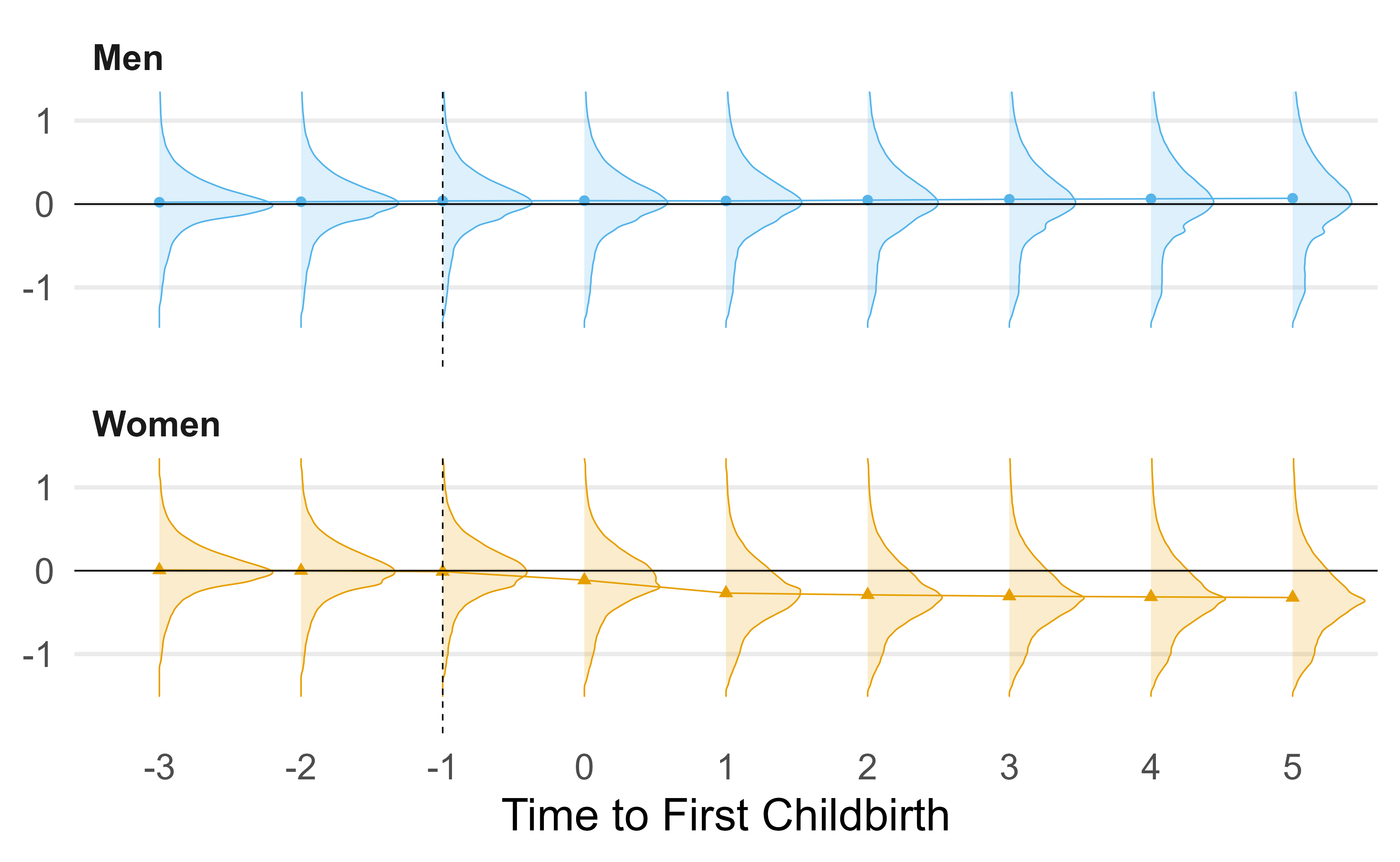
We study the estimation of causal effects on group-level parameters identified from microdata (e.g., child penalties). We demonstrate that standard one-step methods (such as pooled OLS and IV regressions) are generally inconsistent due to an endogenous weighting bias, where the policy affects the implicit weights (e.g., altering fertility rates). In contrast, we advocate for a two-step Minimum Distance (MD) framework that explicitly separates parameter identification from policy evaluation. This approach eliminates the endogenous weighting bias and requires explicitly confronting sample selection when groups are small, thereby improving transparency. We show that the MD estimator performs well when parameters can be estimated for most groups, and propose a robust alternative that uses auxiliary information in settings with limited data. To illustrate the importance of this methodological choice, we evaluate the effect of the 2005 Dutch childcare reform on child penalties and find that the conventional one-step approach yields estimates that are substantially larger than those from the two-step method.
Separations Revisited: Do Layoffs or Quits Drive Lower Separation Rates in High-Quality Firms?
with Daniel Fernandez and Caue Dobbin
Audio summaryNBER Working Paper
CESifo Working Paper
RFBerlin Discussion Paper
A well-known empirical regularity is that high-productivity firms have lower worker separation rates, but it is unclear whether this pattern reflects quits or layoffs. Using matched employer-employee data from Brazil that distinguish the reason for each separation, we show that the productivity–separation gradient is driven primarily by layoffs rather than quits. We then propose and test a mechanism in which downward wage rigidity prevents firms from adjusting wages in response to adverse shocks, causing those shocks to translate into layoffs. High-productivity firms are less exposed because their larger markdowns provide a buffer between productivity and wages. Consistent with this mechanism, we find that firms with higher markdowns have lower layoff rates, and that markets with stronger wage rigidity exhibit both higher layoff rates and a steeper productivity–layoff gradient. These findings suggest that productivity differences across firms shape not only wages, but also workers’ exposure to job loss.

Trading Present for Future: The Long-term consequences of Sex Work
with Nina Buchmann and Sevin Kaytan
The Role of Transfers in Intergenerational Mobility: Cross-country Comparison
Finland team with Montonen Jerry
Digital Inclusion and Labor Market Performance: An Experimental Evaluation
(Forthcoming at SERIEs)
with Miguel Almunia and Aleksei Samkov
Audio summaryThe digital divide limits economic opportunities, particularly for older adults with low education who face barriers to accessing and using digital technologies. We evaluate a randomized intervention targeting disadvantaged individuals aged 45–64 in the Canary Islands, Spain. Over 2,900 participants were assigned to receive either a tablet with internet access, a tablet plus digital skills training, or no intervention. The combined treatment led to significant improvements in digital skills and job search behavior, though not in employment outcomes. Tablet-only recipients showed smaller gains, concentrated among those with low initial skills. These results suggest that bridging the digital divide requires not just access to technology but also targeted support to build digital capabilities.
